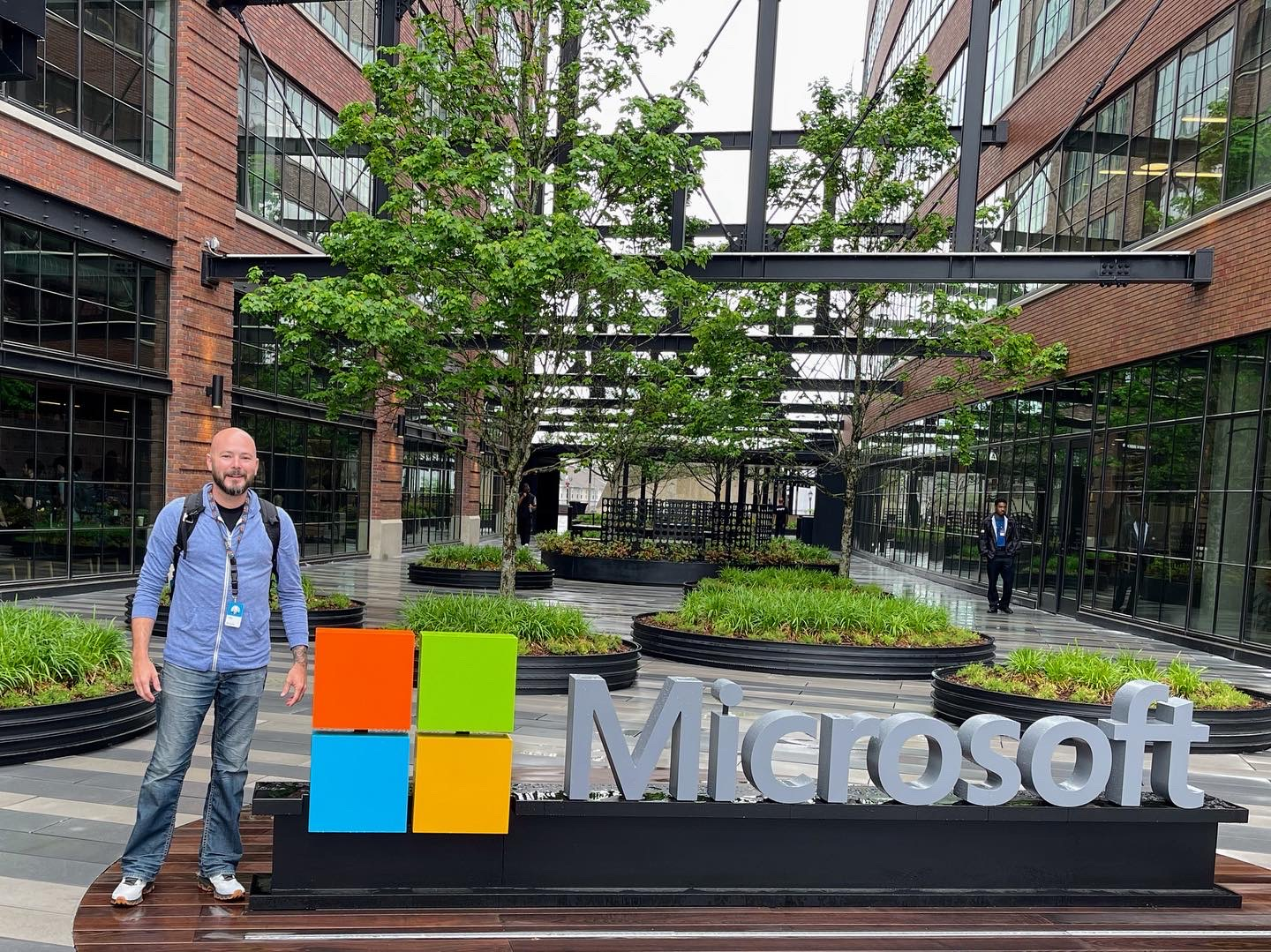
On January 27, 2025, it will be fifteen years since I joined Microsoft.
I am writing this reflection a few weeks early. I have a rather big surgery coming up in January, and I wanted to put these thoughts into words before then.
Anniversaries usually invite us to look backward. Preparing for surgery has a way of sharpening that instinct. It makes time feel less abstract and gratitude feel more immediate.
When I wrote about my first year, I was trying to determine whether I belonged here.
At five years, I was learning that experience changes the questions we ask.
At ten years, I found myself in a customer classroom teaching Azure and reflecting on how much both Microsoft and I had changed.
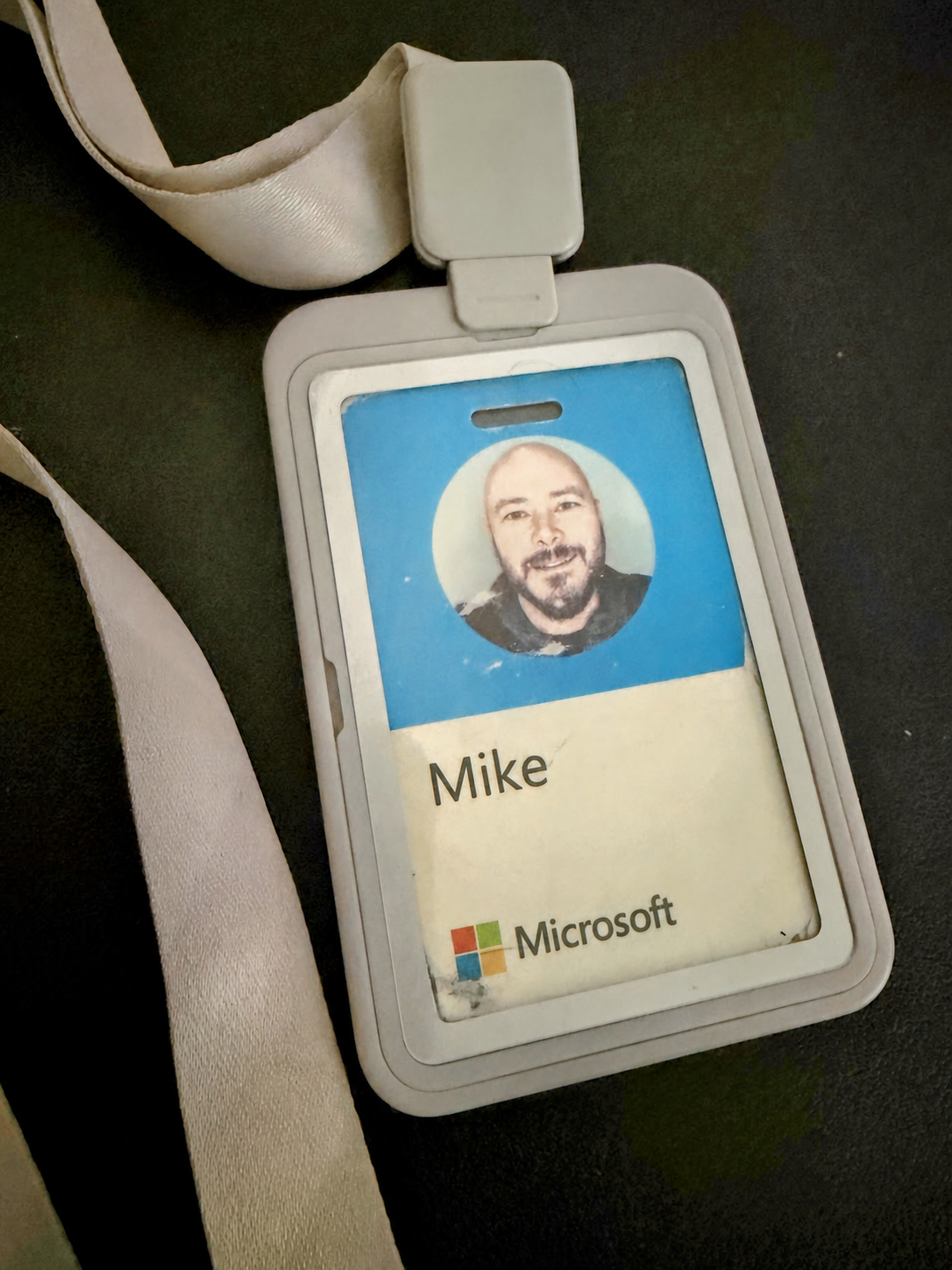
Over the years, I picked up a few replacement badges. This is the latest one. Its photograph has faded, the edges are worn, and the surface is scratched and scuffed—a small reminder that even the objects marking a career have chapters of their own.
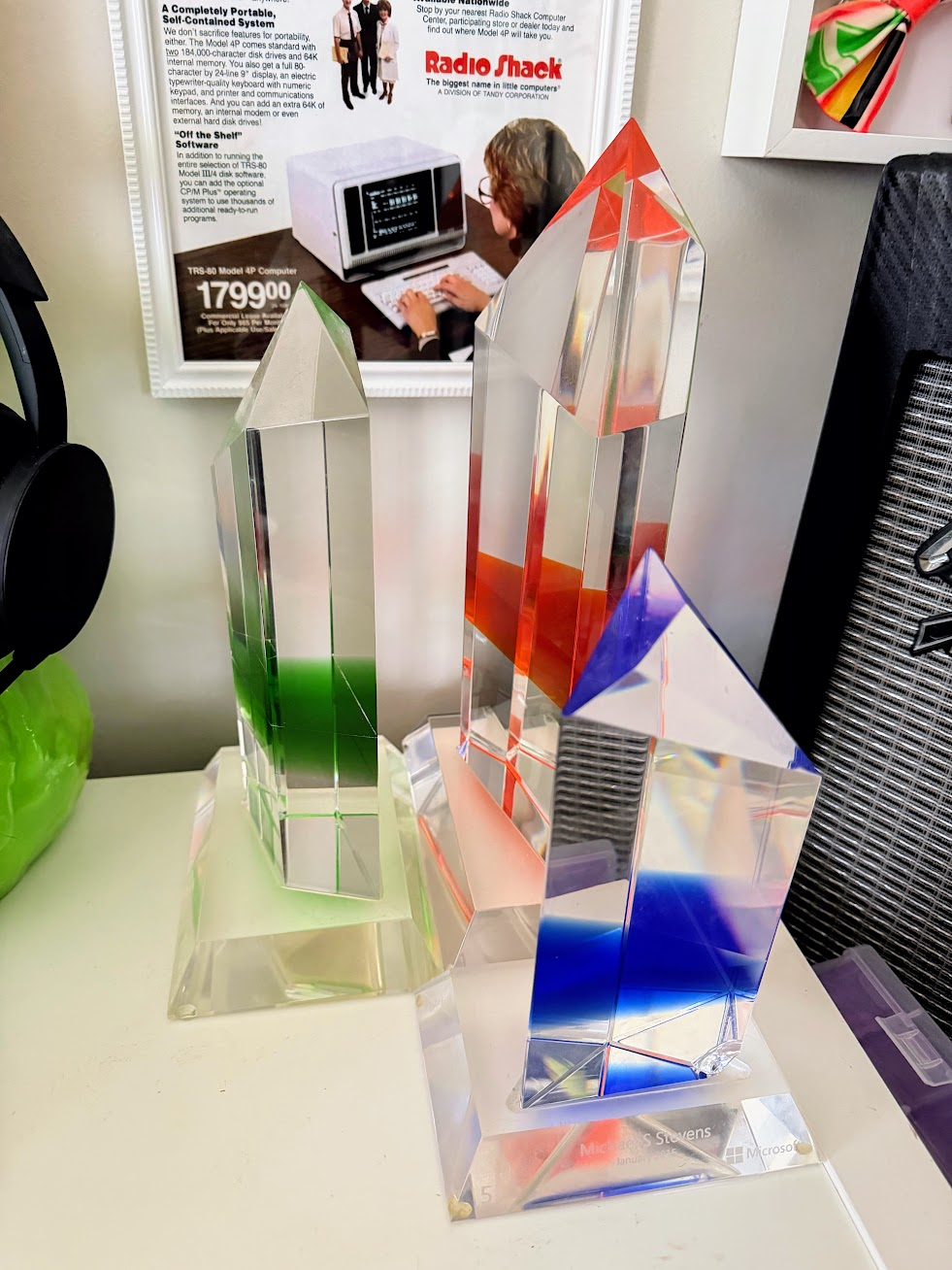
Over time, the badges were joined by a small collection of anniversary crystals: blue at five years, green at ten, and orange at fifteen. Together, they make the passage of time look much tidier than it felt while living it.
Fifteen years feels different.
This anniversary has me thinking less about technology and more about systems.
Not computer systems.
Human systems.
Teams. Organizations. Customers. Programs. The thousands of interactions that somehow become products, services, communities, companies, and careers.
Looking back over the last five years, that seems to be the thread connecting almost everything I have done.
Five Unexpected Years
My ten-year post was published in January 2020.
I wrote it from Cincinnati, where I was onsite with a customer delivering Azure training. The week involved a classroom, flights, a hotel, and a plate of Skyline Chili buried under an improbable amount of cheese.
What I did not know while writing that post was that the entire world was about to change.
Within weeks, classrooms disappeared. Travel stopped. Meetings moved online. Organizations everywhere were forced to adapt. Microsoft described the moment as a sudden global shift to remote work, but living through it felt less orderly than that phrase suggests. Most of us were figuring out what worked while the work was already happening.
The irony is that I had spent much of the previous year helping customers build cloud skills. Suddenly, everyone was getting an accelerated lesson in remote collaboration, digital operations, and organizational resilience.
Nobody knew exactly what was coming next.
That uncertainty shaped the next chapter of my career.
The End of One Chapter
When I reached ten years at Microsoft, I was part of the original Enterprise Skills Initiative team in Worldwide Learning.
Helping build that program remains one of the most rewarding things I have had the opportunity to do. The mission was straightforward: help organizations develop the skills they needed to adopt Azure successfully.
The work involved training, learning plans, certifications, customer engagement, and a great deal of coordination across account teams. It was less about teaching a particular Azure service and more about helping organizations create the capability to use the cloud effectively. Microsoft later described the Enterprise Skills Initiative as a programmatic way to identify knowledge gaps, connect learning to customer initiatives, and measure progress.
Like many Microsoft roles, however, the work evolved.
Eventually, so did I.
From Learners to Builders
The next major chapter took me into Azure Customer Experience, or CXP, and into work focused on startups, software companies, and independent software vendors.
At first glance, it seemed like a dramatic change. Instead of helping organizations consume technology, I was suddenly helping organizations build technology.
The reality was more nuanced.
The questions were familiar:
- What are you building?
- What problem are you trying to solve?
- What is blocking you?
- How can Microsoft help?
The customers were different. The pace was different. The constraints were different.
The startup building its first product and the global software company operating at hyperscale shared surprisingly similar challenges. Both were trying to bring solutions to market, serve customers, and navigate a rapidly changing technology landscape.
The work centered on technical enablement, architecture reviews, marketplace publishing, engineering feedback, and removing barriers between builders and product teams. Across Microsoft, the broader ISV journey was increasingly organized around helping software companies build, publish, and grow with the Microsoft Cloud.
Some of the most rewarding conversations during this period came from working with the people building the future rather than merely deploying it.
FastTrack for Azure—ISVs and Startups
The FastTrack for Azure—ISVs and Startups team, or FT-ISV, brought that builder-focused work to life. We worked directly with independent software vendors and startups to help them design, build, and scale solutions on Azure. This video captures the team and the kind of opportunity we were inviting people to join.
Watch the FastTrack for Azure—ISVs and Startups video on LinkedIn
Scale Changes the Job
One thing became increasingly clear during this period.
The farther you move above individual engagements, the more your job becomes about systems.
Early in my career, I might spend weeks helping a single customer solve a technical problem. Today, I am more likely to ask:
- Why does this pattern keep occurring?
- What are we learning across customers?
- How do we scale what is working?
- How do we eliminate friction?
- How do we connect the right people?
I found myself becoming increasingly interested in feedback loops.
Not just customer feedback.
Engineering feedback. Program feedback. Operational feedback.
The kinds of patterns that only emerge after many engagements.
One of the most fascinating aspects of CXP work was seeing how customer experiences could influence engineering priorities. Individual projects mattered, but the broader opportunity was identifying recurring themes and helping product teams understand what builders were encountering at scale.
The work became less about solving one problem and more about improving the environment in which problems get solved.
That shift took me a while to appreciate.
Now I find it fascinating.
Startups, ISVs, and the Future
One of the recurring themes throughout this period was working with organizations born in the cloud.
Earlier in my career, most customer conversations involved migration.
How do we move this workload? How do we modernize this application? How do we get to the cloud?
Increasingly, those questions disappeared.
The next generation of customers often started in the cloud. Their questions were different.
How do we scale? How do we automate? How do we monetize? How do we build resilient platforms? How do we reach millions of users?
The technology stack kept evolving, but the entrepreneurial energy remained remarkably consistent. It was impossible to spend time around startups and builders without absorbing some of that optimism.
Microsoft’s public programs evolved alongside those needs. ISV Success brought technical consultations, developer resources, marketplace publishing, and go-to-market support into a more unified path. Microsoft for Startups increasingly connected founders with Azure, AI models, credits, and expert guidance.
The names and program boundaries changed. The builder’s fundamental question did not:
Can you help us move forward?
And Then AI Happened
The cloud dominated much of my second decade at Microsoft.
AI feels like it may dominate the third.
It is difficult to overstate how quickly the conversation changed. In a surprisingly short period, discussions shifted from cloud adoption, modernization, containers, Kubernetes, and application architecture toward copilots, agents, generative AI, developer productivity, and AI-enabled experiences.
The interesting thing is that AI did not replace the previous conversations.
It layered on top of them.
Organizations still need platforms. They still need applications. They still need security, governance, architecture, reliability, and engineering discipline.
What changed was the set of possibilities being discussed.
Microsoft introduced Azure OpenAI Service by invitation in November 2021 and announced its general availability in January 2023. By the end of that year, Azure OpenAI was helping power an expanding Microsoft Copilot ecosystem.
By 2024, Copilot, Azure OpenAI, custom AI applications, developer acceleration, and increasingly agents appeared everywhere from customer engagements to program planning. Microsoft was publicly describing how ISVs, digital-native companies, startups, and partners were building on the Copilot stack.
For someone who spent much of his first decade explaining SharePoint farms and SQL clusters, it has been a fascinating thing to witness.
Leadership Looks Different Than I Expected
Fifteen years ago, I probably had a very traditional idea of leadership.
I assumed leadership meant having answers.
Experience slowly convinced me otherwise.
Today, leadership feels much more like creating clarity.
Helping people make decisions. Helping teams connect. Providing context. Removing blockers. Building trust. Coaching. Listening.
A surprising amount of the work comes down to helping smart people move in the same direction.
That may be the least glamorous definition of leadership imaginable.
It is also the most accurate one I have found.
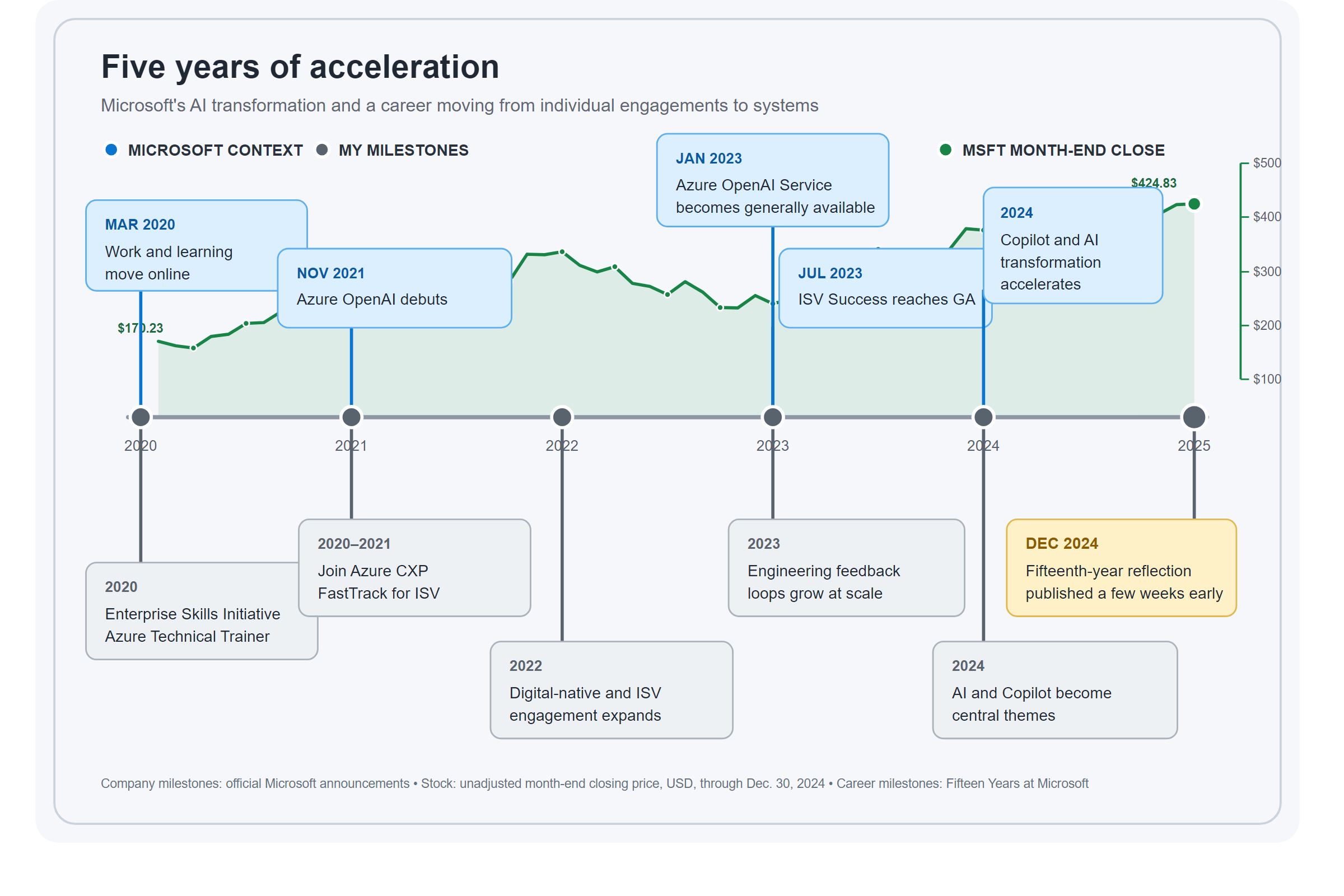
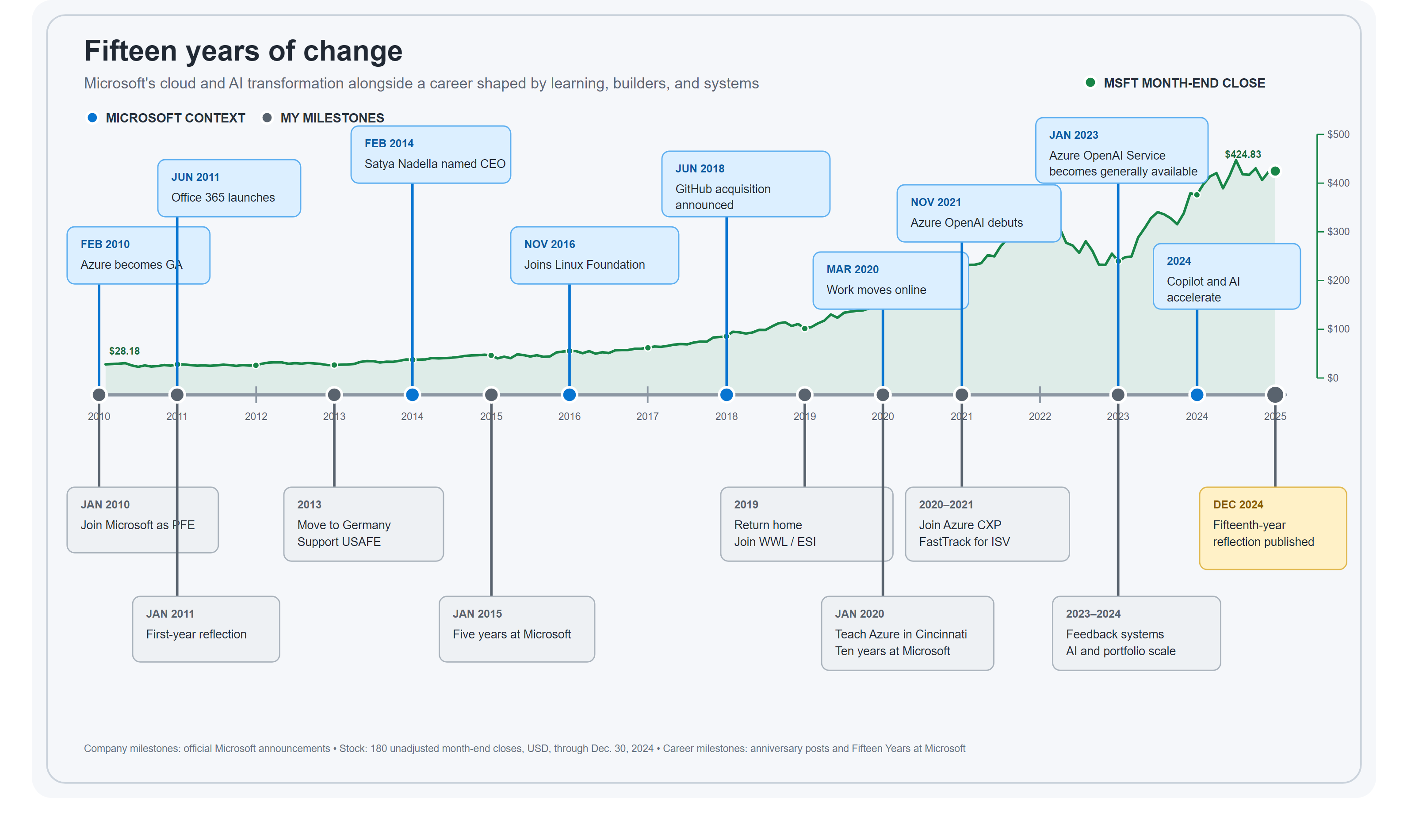
The company context comes from Microsoft’s accounts of the 2020 shift to remote work, Azure OpenAI Service general availability, ISV Success, and AI transformation across the partner ecosystem. The green line uses MSFT’s unadjusted month-end closing prices in U.S. dollars, ending with the December 30, 2024 close because that is this post’s publication date. The career milestones reflect my own experience; organizational and program names are shown as they were relevant to this chapter.
Looking Ahead
At one year, I was trying to figure out whether I belonged.
At five years, I was trying to understand the questions.
At ten years, I was helping others learn.
At fifteen years, I find myself thinking about systems.
How people connect. How organizations learn. How products improve. How communities form. How ideas spread.
And how all of those things ultimately depend on individuals willing to help one another.
The technologies will continue to change.
The product names will continue to change.
The org charts will definitely continue to change.
The human part remains remarkably consistent.
After fifteen years, that may be the most important lesson I have learned.
Related Posts
- My First Year at Microsoft: Learning that nobody succeeds alone
- Five Years at Microsoft: Germany, family, perspective, and the questions that matter more
- Ten Years at Microsoft: Azure, learning, and becoming a beginner again
- Role-based change: Moving into Worldwide Learning, Azure training, and ESI