

I was killing some time this morning in that little window between XC and school drop-off and ended up taking one of those online workplace archetype quizzes.
Apparently, I am The Technocrat.
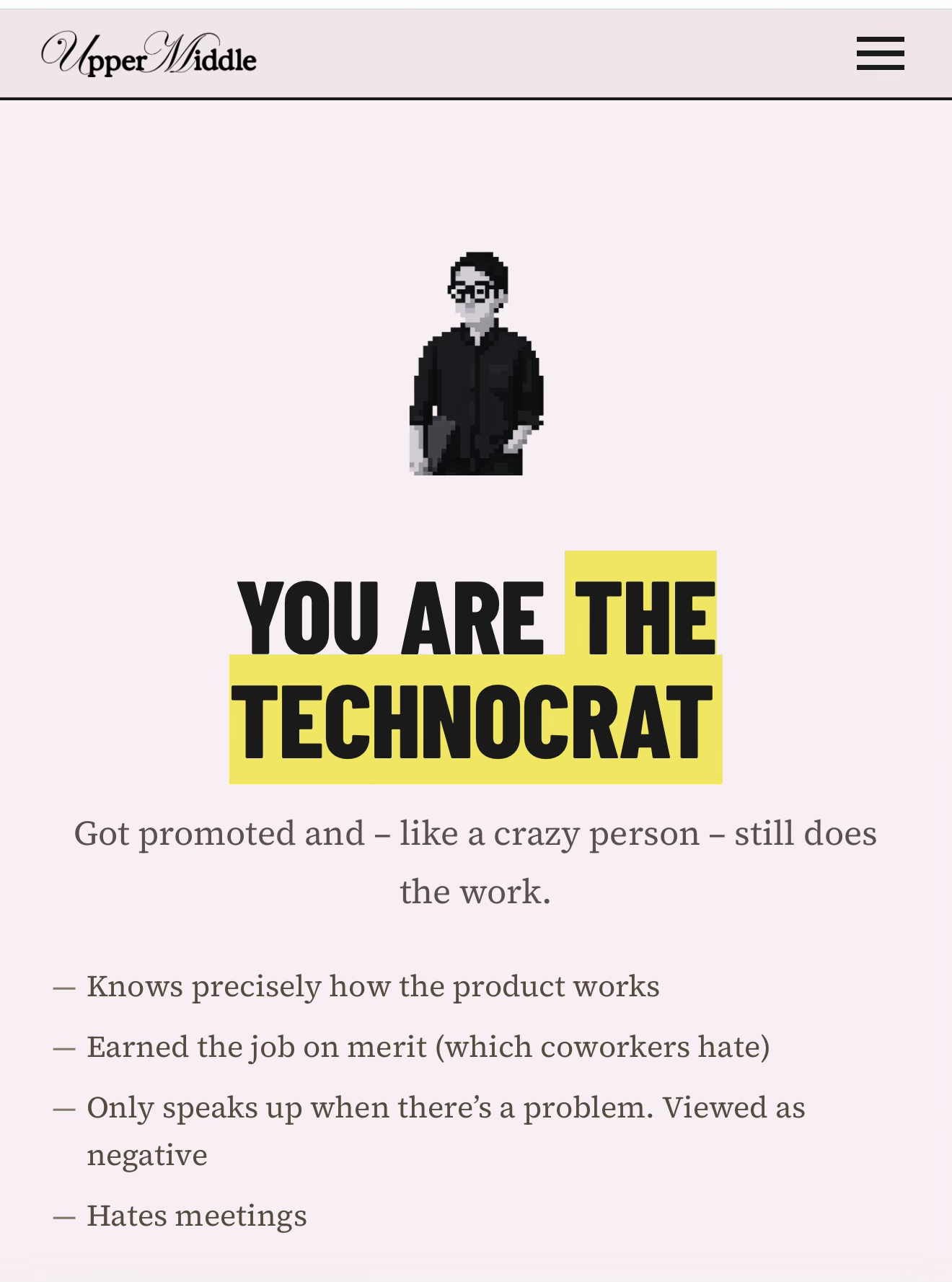
Technocrat sounds much more like a Soviet Cold War term than a workplace personality type. My first thought isn’t corporate America or enterprise technology. It’s someone sitting three levels underground in a concrete bunker surrounded by blinking lights and giant computers, probably doing something they aren’t supposed to be doing.
Maybe the bunker from Lost. Maybe some secret government lab in an ’80s movie where they’re building a cyber soldier and everyone involved is absolutely certain they can control it. There’s probably a general standing behind a scientist asking when it will be ready, and there should definitely be a montage.

Or maybe it’s a character from Tropico, where I’m apparently El Presidente’s newly appointed Minister of Technology, tasked with modernizing the island while the power grid is failing, three factions are threatening revolt, the treasury is mysteriously empty, and somebody keeps building rum distilleries instead of the infrastructure we actually need.


Honestly, that might be the closest analogy.
The little 8-bit Technocrat avatar from the survey only made this better.

The description itself was actually pretty interesting. Their Technocrat is someone who got promoted into management but, for whatever reason, kept doing the actual work. They know how things work, retain a lot of institutional memory, debug processes, answer questions nobody else seems to know the answer to, and tend to speak up when something isn’t working.
There are certainly some pieces of me in there.
I scored a 21 as Technocrat, but the other interesting part was that Play Caller came in right behind it at 18. After those two, the scores dropped off pretty dramatically.
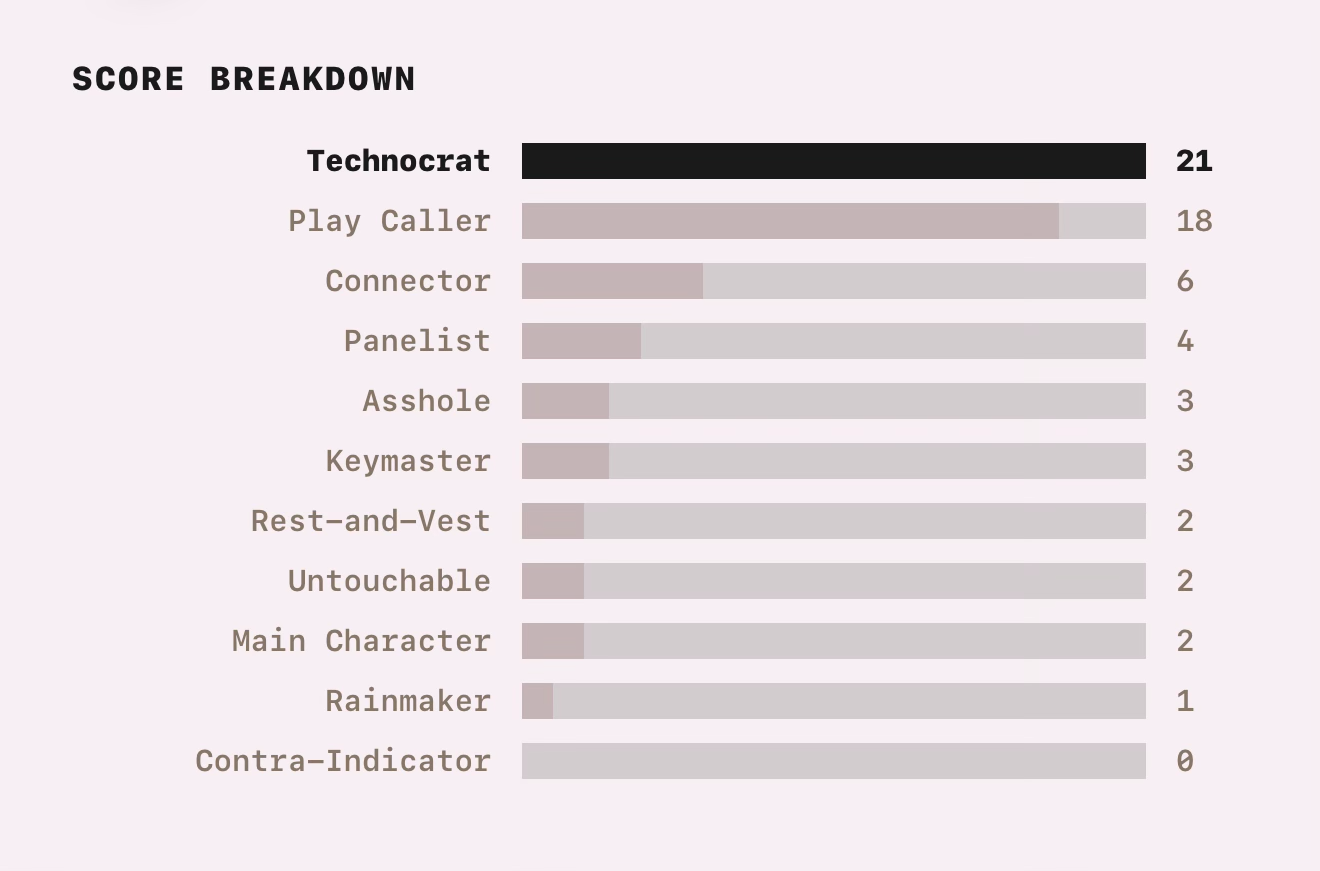
That combination probably says more than either label does by itself. I like understanding how the machinery works, but I also want to do something with that understanding. If the process is broken, fix it. If nobody knows who owns something, figure that out. If we’re depending on one person remembering how everything works, turn some of that knowledge into an actual system. If we keep having the same meeting about the same problem, maybe the meeting isn’t the solution.
The survey also identified my most unexpected answer as my calendar. I said it tends to be back-to-back meetings mixed with travel, conferences, customer visits, and offsites. Apparently this is very un-Technocrat-like. The proper Technocrat, according to them, protects big chunks of time to think and work while the Connector and Play Caller people are out roaming the halls and talking to humans.
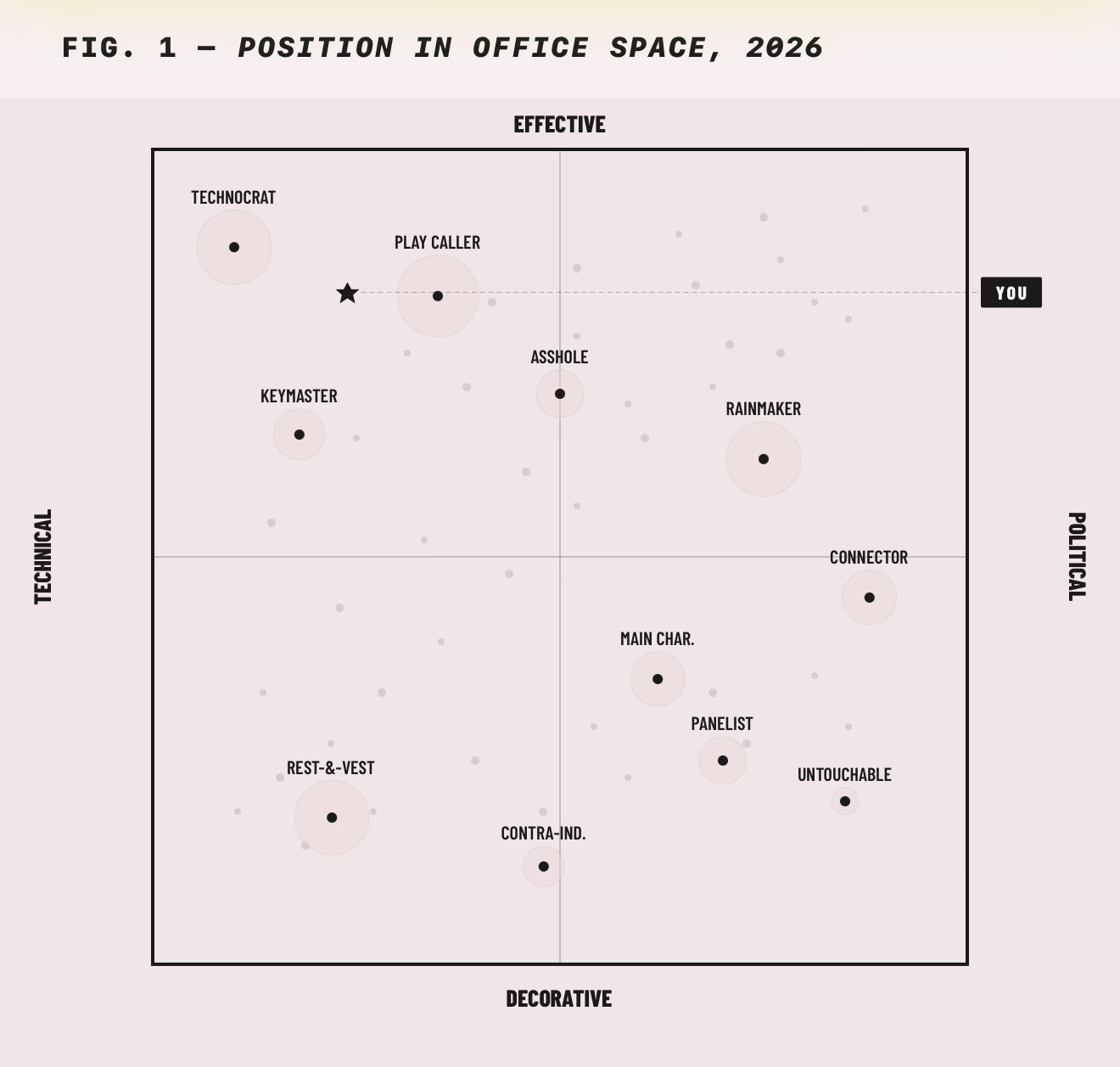
Which probably explains that 18.
There were some accurate observations in the results, some entertaining ones, and I’m sure plenty that could apply to almost anybody who has spent enough years working inside a large organization. I’m not going to reorganize my life around the results of an internet quiz I took while waiting for school drop-off.
It was mostly just a fun little break in the morning, purchased at the possible cost of getting emails for the rest of my natural life asking me to participate in market studies, surveys, and research panels.
Still, I got something out of it.
At a minimum, Technocrat is going into my vocabulary.
From now on, when I hear the word, I’m probably going to picture that little 8-bit character and my brain will wander for a minute into some nostalgia-filled ’80s/’90s sci-fi choose-your-own-adventure. There will be a secret bunker, questionable technology, Cold War intrigue, blinking computer terminals, some completely unnecessary cyber-soldier program that seemed like a perfectly reasonable plot device when I was twelve, and apparently at least a little Tropico mixed in.
I’ll probably also say “Technocrat” to myself occasionally in a terrible voice that’s somewhere between Borat and, even better, Sacha Baron Cohen’s Admiral General Aladeen from The Dictator, with maybe a little of the Soviet bureaucratic absurdity of The Death of Stalin thrown in for good measure.
I’ll smile, maybe even giggle at my own stupidity, and then get back to the grind of knowing how the machinery works, figuring out why it doesn’t, and trying to make it work a little better.
Apparently, there’s a word for that now.
Down the rabbit hole
Fair warning: this rabbit hole is larger—and considerably deeper—than the average one.

- Technocracy — the actual political and intellectual idea is considerably more serious than the little 8-bit guy. Broadly, it is the idea of technical experts exercising governmental or administrative power.
- The Barnum effect — the psychological tendency to see broad or general personality descriptions as uniquely applicable to ourselves. A useful concept to keep nearby whenever an internet quiz seems to know you a little too well.
- When Online Survey Respondents Only ‘Select Some That Apply’ — Pew Research Center on something easy to forget while taking these things: the way a survey asks a question can materially change the answers it gets. Even “select all that apply” versus asking about each choice individually produces different results.
- Writing Survey Questions — a deeper Pew rabbit hole on wording, ordering, forced-choice questions, double-barreled questions, and all the little decisions hiding behind a questionnaire.
- BuzzFeed Personality Quizzes — because the internet took our longstanding desire to have a questionnaire explain who we are and turned it into an art form. Personality tests, fandom quizzes, food quizzes, archetypes, and the occasional attempt to determine your essential nature from a charcuterie board.
- BuzzFeed’s AI-powered “Infinity Quizzes” — a particularly fitting stop in the evolution of the internet quiz. BuzzFeed says its quizzes have been part of internet culture since 2013; naturally, the format eventually met generative AI.
- Tropico — El Presidente, a fictional Caribbean island, economics, infrastructure, factions, politics and plenty of Cold War absurdity. In retrospect, perhaps Technocrat training disguised as a video game.
- The Death of Stalin — Armando Iannucci’s very dark, very funny satire of the scramble for power after Stalin’s death. If Tropico supplies El Presidente and The Dictator supplies the voice, The Death of Stalin supplies the committee meetings, terrified functionaries, institutional dysfunction, and the general sense that everyone technically has a job while nobody has any idea what they’re supposed to do.
There is an entire other rabbit hole here about the Barnum effect, pseudopsychology, survey design, and our apparently bottomless human appetite for answering twelve questions and having a computer tell us who we are. The internet didn’t invent that impulse, but from personality tests to BuzzFeed quizzes to workplace archetypes, it has gotten remarkably good at feeding it.