
The people who save the day deserve our gratitude. The systems that keep every day from needing to be saved deserve our attention.
In 1987, my dad bet me $100 that I couldn’t go an entire year without watching television.
For a kid, $100 felt like a fortune, so I accepted. We negotiated one exception: I could watch the NCAA men’s basketball championship game. Indiana University was playing Syracuse, and there was no chance I was missing it. Keith Smart hit the famous baseline jumper, Indiana won 74–73, and then my television went dark again.
I held up my end of the bargain. Without television filling the hours, I read. A lot. I read enough books to keep the Pizza Hut BOOK IT! coupons coming, expanded my vocabulary, and wandered into subjects I probably would not have found otherwise. Looking back, I am grateful my dad duped me into the bet. He could have spent a year telling me to read more or arguing with me about screen time. Instead, he changed the environment and let the behavior follow.
At the end of the year, he paid me the $100. I immediately used it to buy a Nintendo Entertainment System, hooked it up to a 13-inch black-and-white television with rabbit ears, and proceeded to spend most of my waking hours playing Super Mario Bros., Duck Hunt, Contra, and just about anything else I could get my hands on.
So, yes, the system worked. Maybe not exactly as intended forever, but it worked.
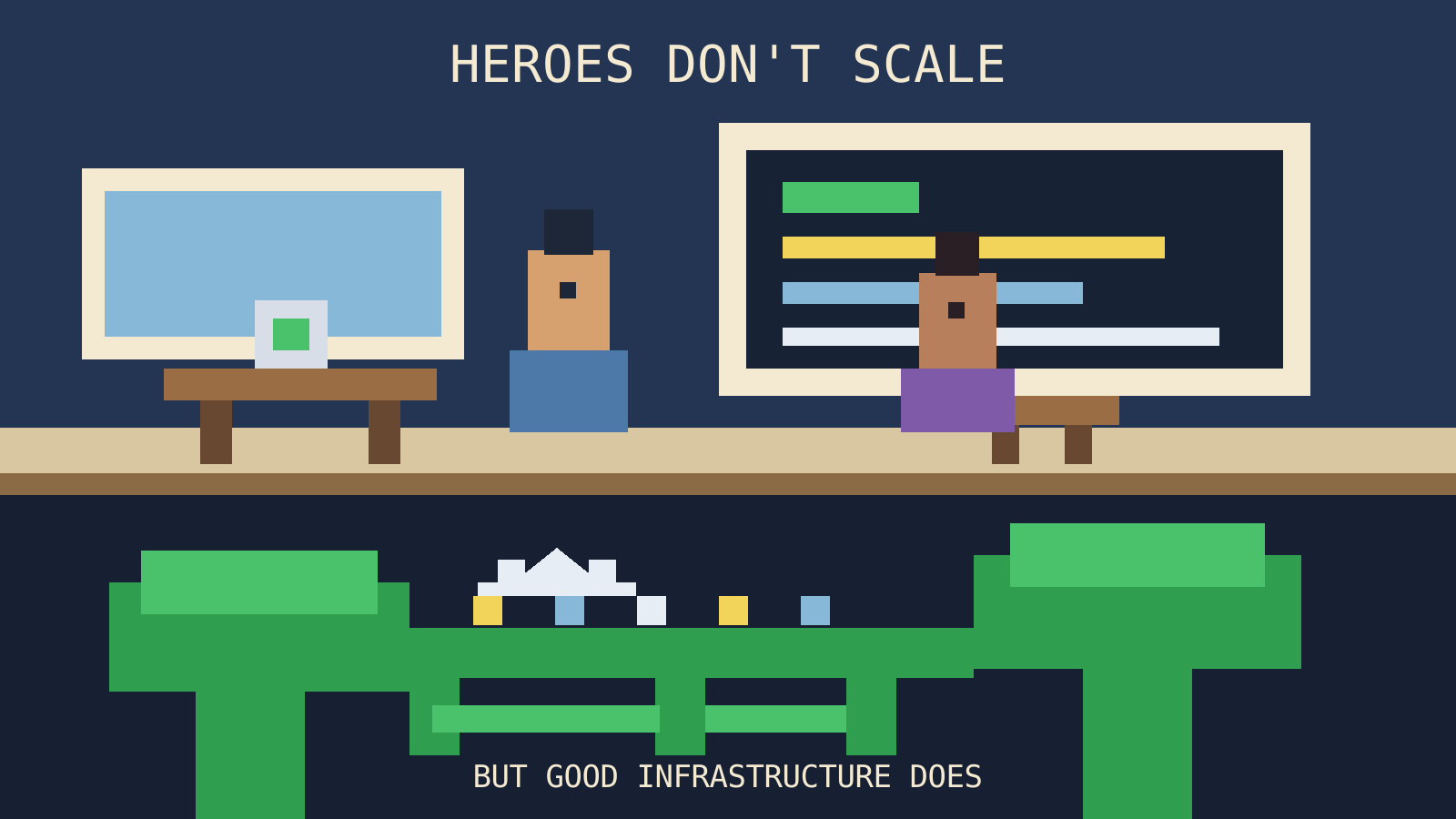
I did not think much about the green warp pipes in Super Mario Bros. at the time. They were simply part of the game: jump in here, pop out somewhere else, and keep moving. They were not the hero, the destination, or even the most exciting part of the level. They were infrastructure, quietly helping the world work.
That is how I have come to think about operations.
Nobody notices the warp pipes
The best operational work usually lives behind the walls. It is the documentation that answers a question before someone has to ask it, the shared vocabulary that keeps several teams from using the same word to mean different things, and the governance that clarifies ownership before priorities collide. It is the dashboard people trust, the onboarding guide that does not depend on who happens to be available, and the process that still works when the expert is on vacation.
When those systems are healthy, they rarely become the topic of conversation. People simply get their work done.
When they are not healthy, we compensate with heroes.
Most organizations have a few people everyone calls when something breaks. They know which spreadsheet is current, how the report is really calculated, where the exception is buried, or why one customer has to be handled differently from all the others. They carry enormous institutional knowledge and often take genuine pride in helping everyone else succeed.
The problem is not having heroes. The problem is building an organization that depends on them.
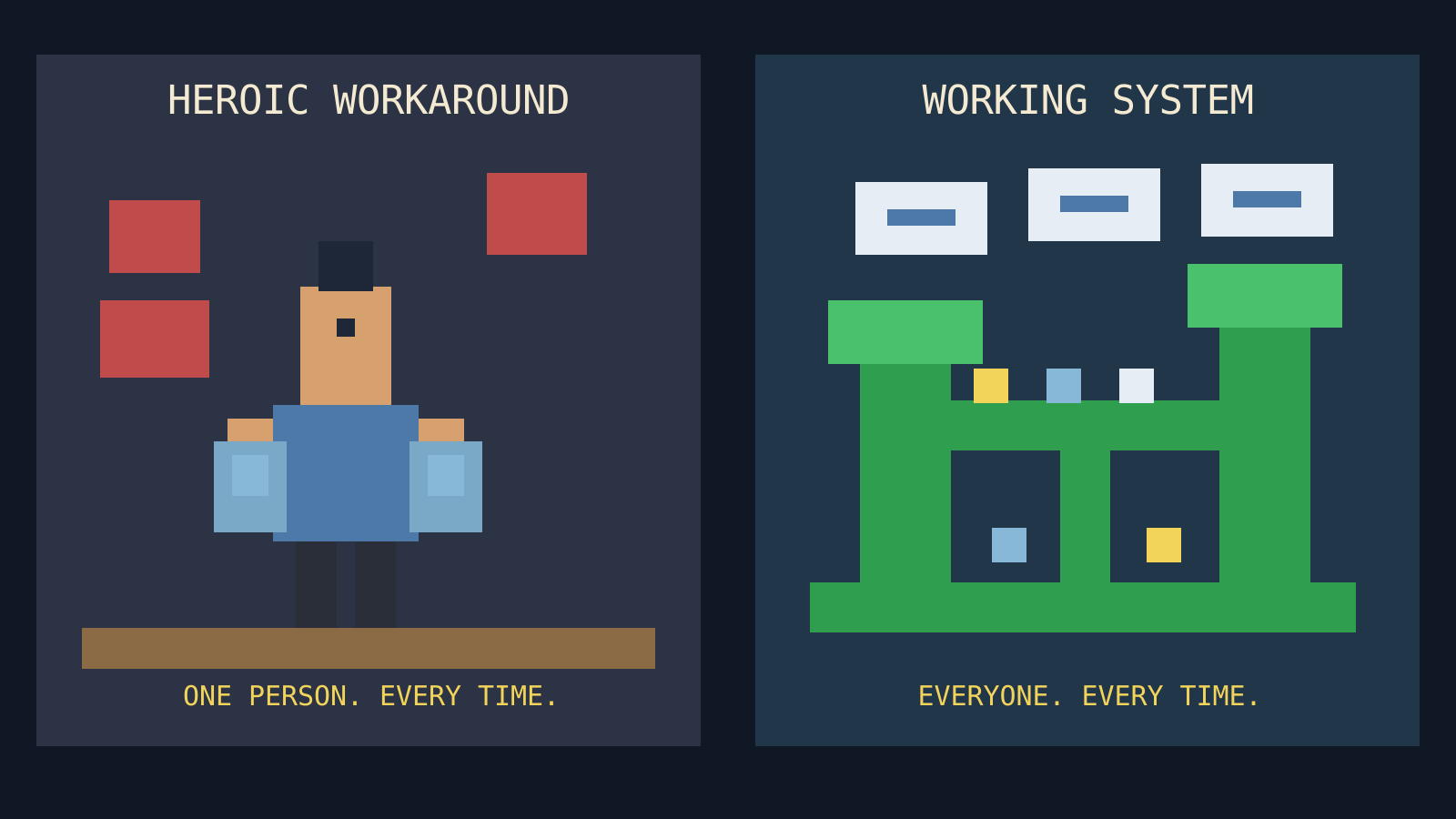
I say this often: heroes don’t scale.
A hero can save today. A system can keep every tomorrow from needing to be saved.
W. Edwards Deming captured the same idea more sharply: “A bad system will beat a good person every time.” The point is not that individual effort is irrelevant. It is that effort eventually loses when it has to fight the same broken structure every day.
Every undocumented exception, manual reconciliation, and “just ask Sarah” instruction quietly makes the organization more fragile. It may feel efficient because the immediate problem gets solved, but the solution does not spread. As the work grows, the organization simply asks more from the same few people.
Adoption before optimization
I have seen this pattern repeatedly in my own work. In one recent discussion, a team was eager to redesign the structure of a program before the existing model had really been adopted. The suggestions were not wrong. Some of them were probably improvements. My concern was simply that we were trying to optimize a road people had not yet started using.
My response was essentially: we need to drive adoption first.
That can sound less ambitious than a redesign, but adoption is where a system becomes real. A beautifully designed process that nobody uses is not infrastructure. It is a diagram.
The same lesson surfaced in a separate conversation about an Operator’s Manual and a broader knowledge base. At first, the problem sounded like a familiar one: where should all the information live? As we talked, it became clear that we were actually trying to combine three different things.
One was authoritative operating guidance: curated, owned, and deliberately maintained. Another was fast-moving working knowledge: useful notes, examples, schemas, and emerging practices that needed a lower barrier to contribution. The third was reusable tooling and code, which needed version control, testing, and technical stewardship.
Putting everything in one repository might have looked simpler on an architecture slide, but it would have blurred the signals people and AI both need. Which guidance is authoritative? Which note is still evolving? Which asset is executable? The information was related, but it did not all need the same shape.
That discussion was not really about documentation. It was about plumbing.
AI does not eliminate the pipes
AI has made this more important, not less. There is a growing hope that a sufficiently capable model can organize years of accumulated documents, trackers, transcripts, and contradictory definitions. It can certainly help, but it cannot manufacture trust where the organization has never established it.
If five teams define customer health differently, AI can summarize all five definitions. It cannot decide which one the organization intends to govern by. If the official process is outdated but everyone follows an undocumented workaround, AI has no reliable way to know that the workaround became the real process. If a critical answer lives only in one person’s head, adding an AI assistant does not remove the bottleneck. It simply confirms that the person is part of the workflow.
AI is not replacing heroes so much as exposing where we have been relying on them.
The organizations that gain the most from AI will not necessarily be the ones with the flashiest demos. They will be the ones with clearer ownership, more trustworthy information, consistent terminology, and systems people actually use. Intelligence amplifies infrastructure. Strong pipes become more valuable; weak ones leak faster.
This is where John Gall’s observation about systems is useful. Gall wrote that a complex system that works is invariably found to have evolved from a simple system that worked. That is a good warning for anyone tempted to solve every operational problem with a grand redesign. Start with something useful. Get people using it. Learn from where it bends or breaks, and then improve it.
Build the pipe before the pipe network.
The quiet evidence of good operations
The irony is that the best evidence of operational excellence is often an event that never occurred. The outage that did not escalate. The customer who did not have to ask twice. The meeting that was unnecessary because ownership was already clear. The new employee who found the answer without first learning the unofficial list of people worth asking.
Those successes are difficult to celebrate because they do not produce dramatic rescue stories. Nobody gathers around to applaud the pipe that did not burst.
We should still celebrate the people who step in when things go sideways. There will always be moments when experience, judgment, and stamina matter. Mario still has to jump over the gap and reach the castle.
But when the same names appear in every crisis, when every report requires the same person to reconcile it, or when a process works only because somebody remembers all of its exceptions, we should look behind the walls before applauding the latest rescue.
The highest compliment an operations team can receive may not be, “We couldn’t have done it without them.” It may be that the work flowed so naturally nobody stopped to wonder how.
The water ran. The lights stayed on. The answer was where it was supposed to be. Mario reached the castle, and everyone assumed it had always been that easy.
That is what good systems do.
Because heroes don’t scale.
Rabbit holes
- W. Edwards Deming: “A bad system will beat a good person every time.”
- Gall’s Law and why working complex systems evolve from working simple ones
- The Goal by Eliyahu M. Goldratt, a classic introduction to constraints and systems thinking
- The Mythical Man-Month by Frederick P. Brooks Jr., including the enduring lesson that adding people does not automatically make late work move faster
Super Mario Bros., Nintendo Entertainment System, Duck Hunt, and Contra are referenced as part of a personal story and cultural commentary. The illustrations in this post are original and are not Nintendo artwork.