
This week marks ten years since I joined Microsoft.
Unlike my first anniversary, I didn’t spend much time thinking about this one ahead of time. Ten years arrived quietly while I was onsite with a customer in Cincinnati delivering Azure training. The week looked remarkably similar to hundreds of other travel weeks over the last decade, complete with flights, hotels, demos, slide decks, customer questions, and the usual collection of chargers and adapters that seem to multiply inside every consultant backpack.
The customer even took us out for Cincinnati’s famous Skyline Chili. What a way to celebrate ten years at Microsoft!

Celebrating that way felt appropriate. When I joined Microsoft in January 2010, I could not have predicted where the next ten years would lead. I certainly did not have “living in Germany,” “supporting USAFE,” “teaching Azure,” or “helping customers build cloud skills” anywhere on my list.
The career I imagined in 2010 and the one I am living in 2020 are related, but they are not quite the same story.

Microsoft Changed
One challenge in reflecting on a ten-year anniversary is separating personal change from organizational change. Microsoft was a very different company in 2010. Windows Server, SharePoint, Exchange, SQL Server, System Center, and enterprise infrastructure dominated many customer conversations. Most of my early work involved deployments, migrations, troubleshooting, architecture reviews, support cases, and the daily business of keeping important systems healthy and available.
The cloud was not entirely new to me. Some of my earliest commercial-sector cloud work involved Business Productivity Online Suite (BPOS) and BPOS Dedicated, the hosted services that preceded Office 365. At the time, it felt less like leaving the datacenter behind than learning where its boundaries had moved.
Azure existed, but it was still early, and the names alone chart the learning curve. What began inside Microsoft as Project Red Dog emerged publicly as Windows Azure. Windows Azure and SQL Azure became generally available on February 1, 2010, just days after I joined the company. In 2014, Windows Azure became Microsoft Azure. Learning the cloud involved far more than keeping up with a changing name because it required us to reconsider architecture, operations, identity, security, and the way services were delivered.
The following year, Microsoft launched Office 365, bringing Office, SharePoint, Exchange, and Lync together as cloud services. Most organizations were not yet betting their future on the cloud, but the direction was becoming clearer.
Satya Nadella became CEO in 2014 and articulated the urgency of Microsoft’s transformation:
“Our industry does not respect tradition. It only respects innovation.”
The company increasingly organized around cloud services, digital transformation, subscriptions, developer platforms, and continuous learning. Azure grew from an interesting option into a core part of Microsoft’s future.
The cultural shift became visible in ways that would have been difficult to imagine in 2010. In 2016, Microsoft joined the Linux Foundation as a Platinum member. In 2018, it announced the acquisition of GitHub, describing Microsoft as a developer-first company committed to freedom, openness, and innovation.
As Microsoft changed, customers began asking different questions and looking for skills that had not been part of the conversation a few years earlier. Looking back now, I can see that my career was following much the same course.
“To the Cloud!”
In 2010, Microsoft made the transition memorable with its “To the Cloud!” television campaign. The commercials were playful consumer stories, but the phrase stuck because it named a much larger sea change already underway.
Watch the 2010 “To the Cloud” commercial compilation on YouTube
The slogan made the journey sound easy, but the work was anything but simple. In commercial environments, and especially in OCONUS U.S. Department of Defense and NATO environments, moving from on-premises systems toward the cloud raised hard questions about connectivity, identity, security, data location, accreditation, continuity, and disconnected operations. Although the overall direction was becoming clear, the practical path depended entirely on the mission and the environment.
Germany Became Home
When I wrote Five Years at Microsoft, Wendy and I were raising our family in Germany while I supported United States Air Forces in Europe.
At the time, Germany still felt like a major chapter in our lives. By the end of the decade, it simply felt like life. Many of my favorite memories from those years have little to do with technology. I remember school events, family travel, learning a new culture, and navigating the local bureaucracy. I also remember explaining to visiting coworkers why they absolutely needed a rental car and where they should stay near Ramstein.
Much of the work involved helping people find their footing. Sometimes that meant solving a customer problem, while other times it meant helping a family relocate or showing a new Microsoft employee how things worked. Somewhere along the way, I stopped being the newcomer and became one of the people others called when they needed help understanding the environment. I still find that realization satisfying.
Reviewing old email also reminded me how much time I spent on matters that were not technical at all, including travel arrangements, logistics, customer introductions, training coordination, and relocation questions. None of that work was glamorous, but it often made someone else’s difficult week a little easier.
A Different Kind of Role
By the middle of the decade, my work was becoming less focused on individual technologies and more focused on planning, coordination, and customer outcomes.
I moved through several roles supporting USAFE and related organizations. Although the titles changed, the common thread was helping connect people, priorities, resources, and technology. In one internal résumé from 2016, I described my role as gathering customer requirements, collecting feedback, aligning priorities, coordinating teams, and serving as a trusted advisor between customer organizations and Microsoft delivery teams. That description still feels accurate.
One email from 2016 stands out because it captures both the role and my mindset at the time. After outlining a potential implementation plan for a customer, I ended the note with:
“These notes are rough, and arguably not fully baked, but it is a start, right?”
That line makes me smile because it reflects something I still believe: most meaningful work begins before anybody has all the answers.
Learning Azure
By 2015, the cloud was no longer sitting at the edge of my work. Over the next five years, I moved from those early BPOS and BPOS Dedicated roots into the much broader scope of the Microsoft cloud. By 2017 and 2018, I could see where Microsoft and my own career were heading. Azure appeared more frequently in customer discussions, hybrid scenarios became more important, and organizations wanted to understand how cloud services could fit into the environments they already operated. Like many people at Microsoft, I found myself learning again.
One email from 2018 captured that period perfectly:
“I’ve been digging into it a good bit lately.”
The email included Azure Stack documentation, training resources, certification guidance, videos, architecture references, and deployment scenarios. I was trying to understand how cloud technologies might fit into military and government environments, particularly where disconnected operations, security requirements, and continuity concerns created unique constraints.
What strikes me now is how familiar that process felt. Ten years into my career, I was still reading documentation, following product announcements, asking questions, building labs, and seeking out people who knew more than I did. The products were different, but learning them still required the same habits that had carried me through my first year.
Returning Home
Around the same time I was deepening my Azure experience, our family was preparing to leave Germany and return to the United States.
The move was exciting, but it was also harder than I expected. Returning home sounds easier than moving overseas, yet Germany had become normal. We had routines, schools, friends, favorite restaurants, favorite travel destinations, and a community we genuinely cared about.
Starting over felt strangely familiar because it reminded me of joining Microsoft in 2010. Once again, I was entering a new environment with different expectations, a new role, and unfamiliar people. Apparently, every few years I find a new way to become a beginner.
Enterprise Skills Initiative
One of the largest professional transitions of the decade happened when I left Microsoft Services and joined Worldwide Learning as an Azure Technical Trainer supporting the Enterprise Skills Initiative (ESI). I wrote about the change as it was happening in Role-based change.
Initially, I thought the new role would simply involve teaching Azure, but that proved to be only part of the story.
The more time I spent with ESI customers, the more I realized that the mission was broader than delivering classes. Organizations everywhere were trying to modernize, and having access to new technology did not mean their people were ready to use it effectively. We built learning plans, aligned training with business objectives, explained certification paths, and created programs that could help entire organizations develop lasting capability.
Eventually, I realized that my primary contribution was no longer solving an immediate technical problem for a customer. I was helping customers develop the knowledge and confidence to solve their own future problems, which felt like a meaningful evolution of the work I had been doing all along.
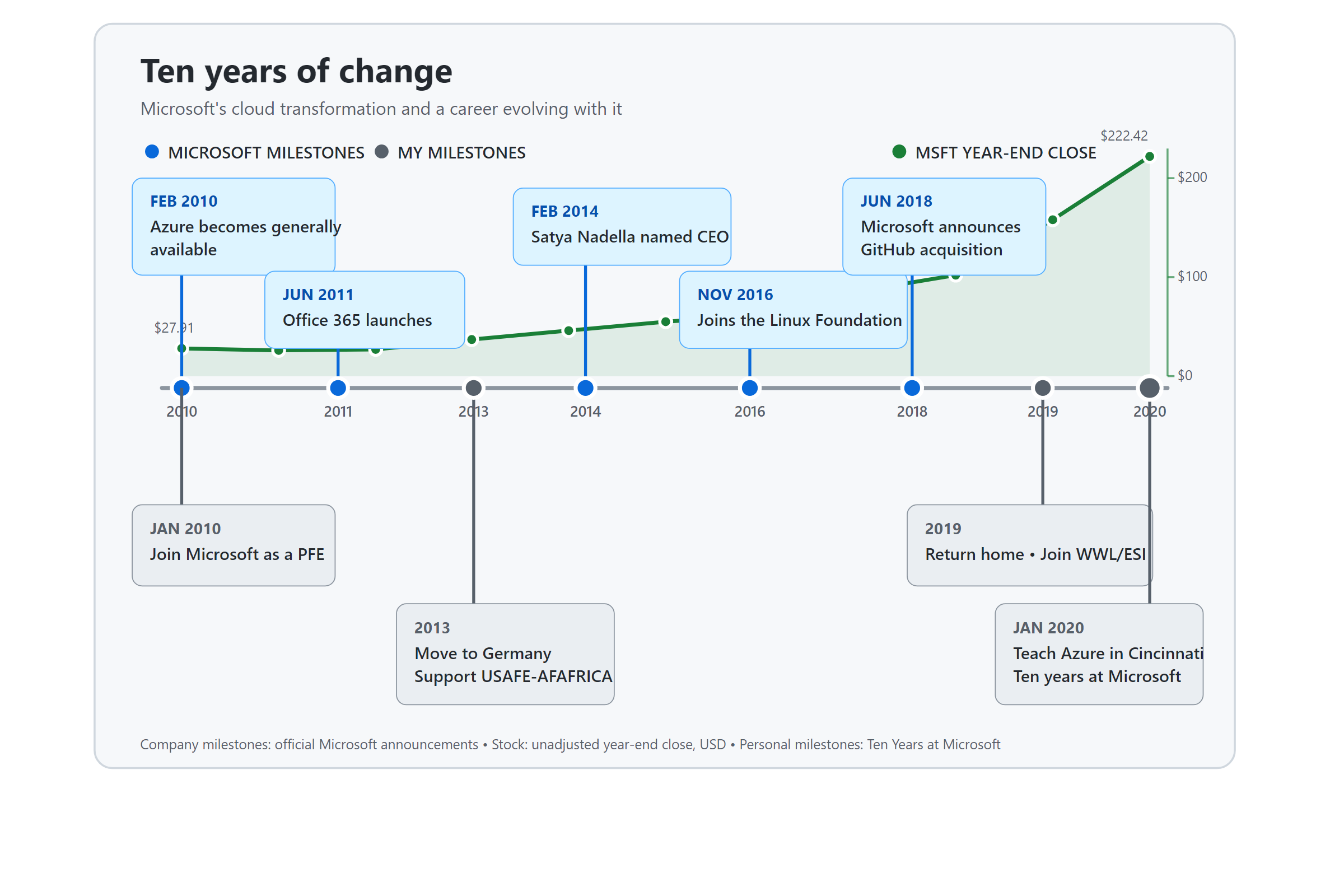
The company milestones come from Microsoft’s announcements for Azure general availability, the Office 365 launch, Satya Nadella’s appointment as CEO, joining the Linux Foundation, and the GitHub acquisition. The green line uses MSFT’s unadjusted year-end closing prices in U.S. dollars.
That green line invites an obvious counterfactual. My initial stock awards might have led to early retirement if I had not sold them along the way for diapers, down payments, and Belgian Trappist beer. I rarely regret those trades, although the chart occasionally tests my resolve.
Still Learning
Looking back through old material, I was surprised by how much time I continued to spend learning even after becoming an Azure Technical Trainer. Course development, Azure certifications, Azure Stack research, customer feedback, technical labs, and regular revisions to learning plans and course content filled a significant part of the job.
In February 2020, my calendar included an Azure DevOps training delivery, an Azure IoT Developer beta certification exam, and technical enablement sessions on Azure demo environments.
Teaching turns out to be one of the best ways to discover what you still don’t know.
One student group kept a class running late because they wanted to continue asking questions. When I later described it to a colleague, I summarized the experience in the most technical terms available:
“They wanted to keep going.”
“Nerds.”
I took that as a compliment.
Looking Ahead
When I joined Microsoft in 2010, I wanted to work for a company I admired.
Ten years later, I am grateful not only for the company, but also for the people, opportunities, and experiences that came with it.
Over those ten years, the technology, the company, and our customers all changed, and my career changed direction several times along with them. Learning was the thread that connected each version of the work.
Looking back, the most valuable thing Microsoft gave me was the chance to become a beginner repeatedly and discover that I could still learn something new. That opportunity mattered more than any particular area of expertise I gained along the way.
I suspect that lesson will remain useful for whatever comes next.
Related Posts
- My First Year at Microsoft: Learning that nobody succeeds alone
- Five Years at Microsoft: Germany, family, perspective, and the questions that matter more
- “Ask not, Have not”: Refusing to reject an opportunity before asking
- Role-based change: Moving into Worldwide Learning, Azure training, and ESI